Costa Atlantica Cruise to Langkawi (1st to 5th June 2013)
An archipelago of 99 islands, the jewel of Malaysia's Kedah state, lies in the Andaman Sea.
A Unesco World Geopark, since 2007.
It is a treasure trove of many legendary tales:
White blood:
Perhaps the best-known legend of Langkawi is that of Mahsuri. Legend has it that the pretty young lady was tied to a tree and stabbed to death after being accused of adultery by her mother-in-law. But as a sign of her innocence, white blood flowed out of her wounds, shocking villagers. As she lay dying, Mahsuri cursed Langkawi to seven generations of bad luck. The locals believe that the legend is true - citing the Siamese invasion of Langkawi, failed crops and the general underdevelopment and obscurity of the area - until recent times, when the seventh generation has apparently lapsed.
Reddish-brown eagle:
Langkawi is named after a giant reddish-brown eagle that descended upon it. In Malay, eagle is helang or simply lang, while reddish-brown is kawi. You can see the locals' tribute to this legendary eagle at Dataran Lang (Eagle Square) at Kuah Town, whose main centrepiece is a majestic sculpture of a reddish-brown eagle poised to take flight.
A short walk from Dataran Lang is Taman Lagenda (Legend Garden) which spans over 20ha. The garden expounds on the many legends.
Feuds and fairies:
From Langkawi's second highest peak, Gunung Mat Cincang, via cable car from Oriental Village, take a breathtaking shot of the surrounding island of the archipelago. This mountain range has its own legend. Apparently, Gunung Mat Cincang and Gunung Raya, the other mountain peak in Langkawi, used to be giants who were about to become in-laws when an indiscretion by the future son-in-law led to a family feud. After a dramatic fight, they were turned into mountains, blessing Langkawi with spectacular landscapes.
Near the Oriental Village is another legendary hotspot, the Telaga Tujuh (Seven Wells) Waterfall. The waterfall is so named after the seven pools or wells that are formed naturally along its path. Water flows from the top of the mountain to the top well, then down to the next, and all the way to the seventh and lowest well. Legends has it that fairies used to come down to these wells to bathe because they possess healing properties.
Pregnant maiden:
From the main Langkawi island, take a short boat ride to Pulau Dayang Bunting to visit the Tasik Dayang Bunting (Lake of the Pregnant Maiden).
Legend has it that a celestial princess who was tricked into marriage decided to bury her dead baby in the lake before flying back to the heavens. Before that, she blessed the lake such that anybody who is barren would be able to conceive after drinking water from this lake. Another interpretation of the legend says that you have to bathe in this lake to be able to conceive.
The lake is the biggest in Langkawi. You can also make out the shape of a pregnant woman lying on her back from the outline of hills and rocky outcrops on one side of the lake.
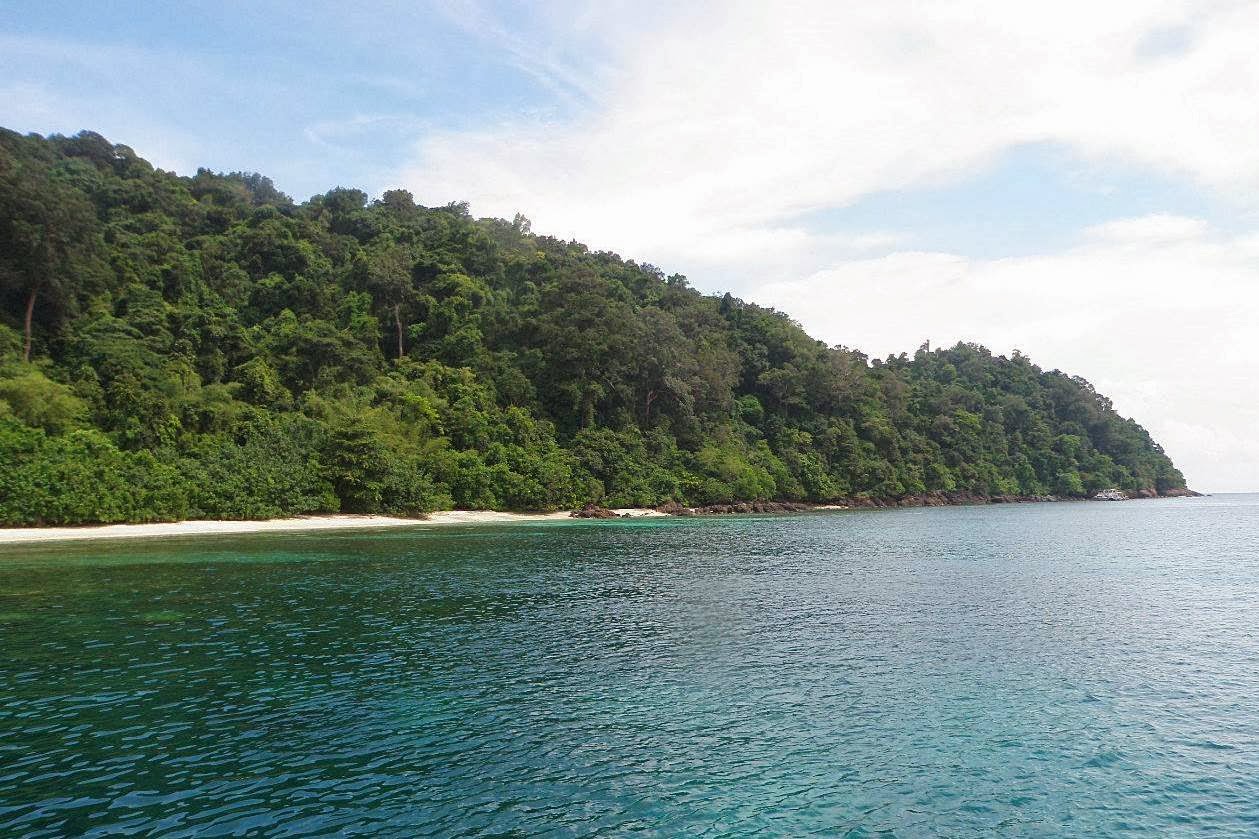
Langkawi from our cruise ship:
From the cruise ship to the tender boat:
View from Langkawi jetty of our cruise ship:
At Langkawi jetty (background: Resorts World Langkawi):
A welcome song:
Eagle Square:
(Also known as Dataran Lang, it is one of Langkawi’s best known manmade attractions, with a large sculpture of an eagle poised to take flight. A sight that greets visitors to the island via ferry, the 12 metre-tall statue is one of the island’s most instantly recognizable monuments.
Located at the southeast corner of Pulau Langkawi, besides offering beautiful views of Kuah Bay, Dataran Lang has beautiful miniature fountains, terraces and bridges, making it the ideal place for those postcard-perfect holiday photos. The square is a good place to watch ferries ply across the harbour but plan a trip here early in the morning or late in the evening when the sun is at its least intense.)
Lake of the Pregnant Maiden:
Rubber Plantation:
Mahsuri Memorial Complex at Mawat Village:
Where Mahsuri was born. Also where she was buried.
Her descendants:
The scene that depicts Mahsuri's trial:
Mahsuri's tomb ground:
Mahsuri's tomb:
Padang Mat Sirat:
(Where Mahsuri was executed)
Pantai Cenang:
A popular seaside destination with many upscale beach resorts.
Underwater World:
Pulau Payar Marine Park:
(The Pulau Payar Marine Park is a series of four gem-green islets strung together to form a marine park. Comprising Pulau Payar, Pulau Kaca, Pulau Lembu and Pulau Segantang, it spans across two nautical miles and is known as Langkawi's premier snorkelling and scuba diving spot)
(Pulau Payar has no accommodation; most people stay at the resorts on Pulau Langkawi, one hour by speedboat to the northwest)
(the islands are located halfway between Pulau Langkawi and Penang)
(They have some of the few coral reefs worthy of note on the western coast, a good representation of marine fauna, more characteristic of the Indian Ocean or the Andaman Sea than the Malaysian seas)
(the visibility is excellent due to their distance form the coast and the murky waters of the Straits of Malacca)
(Between Feb and April, the boom in plankton in these areas attracts large pelagic filtering species such as Mnatas and Whale Sharks)
Note: Diving and Snorkelling on the west coast of Peninsular Malaysia:
the diving areas have prolific marine life, but the visibility is generally poor, even for snorkelling; this is not an area one would visit specifically for its diving; The Payar Marine Park is the focus of the west coast's diving, but it hardly bears comparison with what is on offer elsewhere in Malaysia.
(the poor visibility is due to agricultural run-off, the muddy bottom and the heavy shipping traffic in the area)
Langkawi Cable Car (Skybridge):
(From Oriental Village, ride the cable car to the apex of Gunung Matchincang and get a bird’s eye view of Langkawi’s verdant lushness)
Oriental Village:
cable car:
Skybridge:
Gunung Matchincang:
Telaga Tujuh Waterfalls:
Maps:
Straits Times travel article on 7/8/2012: